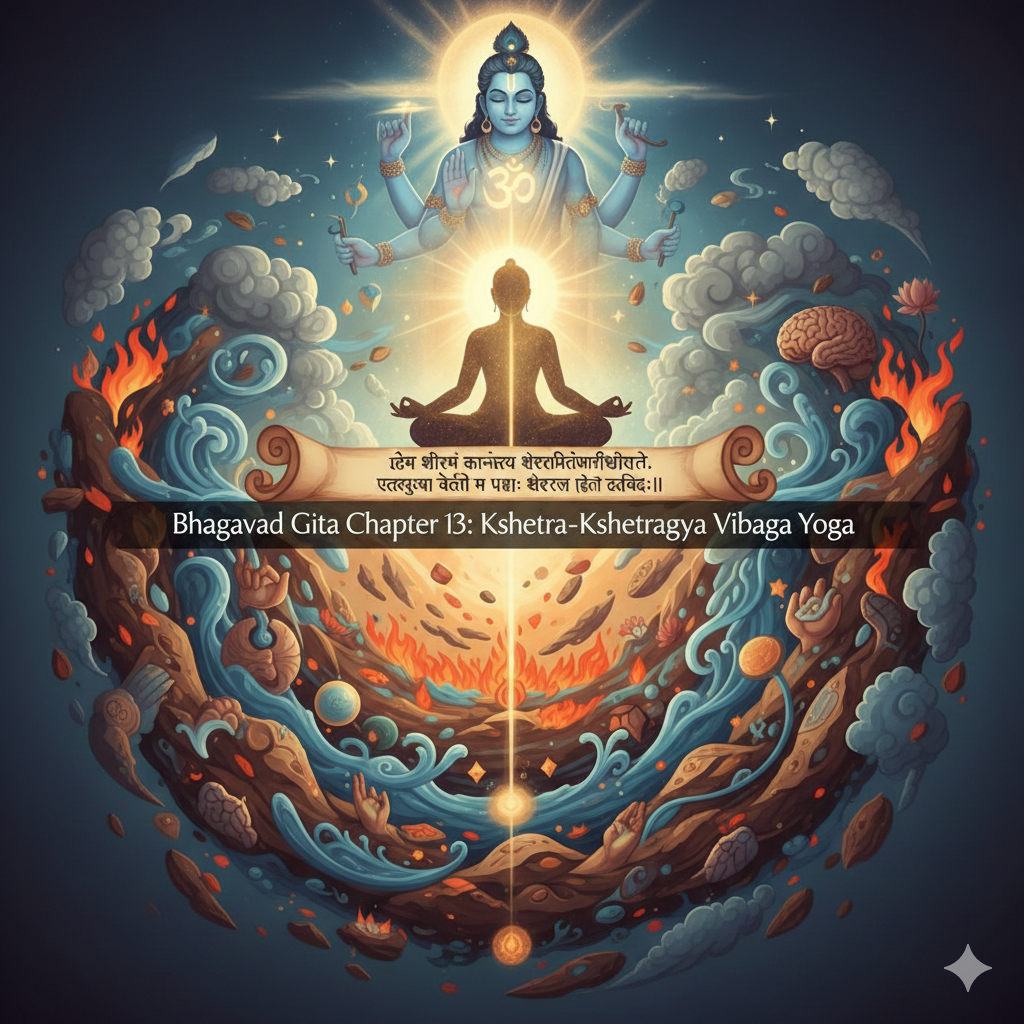
(The Yoga of the Distinction Between the Field and the Knower of the Field)
Introduction
Chapter 13 of the Bhagavad Gita is one of the most philosophical and spiritually profound chapters. In this chapter, Lord Krishna explains the clear distinction between the body (Kshetra – the field) and the soul (Kshetragya – the knower of the field).
This teaching helps seekers understand:
- Who we truly are
- Why suffering exists
- How liberation is attained through right knowledge
This chapter lays the foundation for self-realization, meditation, healing practices, and spiritual awakening.
Central Theme of Chapter 13
Lord Krishna explains three essential truths:
- Kshetra (The Field) – The physical body and material nature
- Kshetragya (The Knower of the Field) – The individual soul and the Supreme Soul
- Jnana (True Knowledge) – Awareness that leads to liberation
Understanding these three leads to freedom from bondage.
What Is Kshetra (The Field)?
The Kshetra is the body and everything that can be perceived or experienced.
It includes:
- The five great elements (earth, water, fire, air, ether)
- Mind, intellect, and ego
- The senses and sense objects
- Desire, aversion, pleasure, pain
- Consciousness as reflected through the body
Everything that is temporary, changeable, and observable is Kshetra.
Who Is Kshetragya (The Knower of the Field)?
The Kshetragya is the conscious principle that knows the body.
There are two knowers:
- The individual soul, aware of its own body
- The Supreme Soul (Paramatma), present in all bodies
Lord Krishna clearly states that He Himself is the Supreme Knower in every field.
True Knowledge (Jnana) According to the Gita
Lord Krishna explains that true knowledge is not mere intellectual learning.
True knowledge includes qualities such as:
- Humility and freedom from ego
- Non-violence and patience
- Respect for the teacher
- Self-discipline
- Detachment from material life
- Awareness of birth, death, old age, and disease
These qualities purify the seeker and prepare the mind for liberation.
Prakriti and Purusha
- Prakriti: Material nature, body, and mind
- Purusha: Conscious soul
Due to ignorance, the soul identifies with the body and becomes bound by karma.
Through knowledge, this false identification ends, leading to freedom.
Paths to Liberation Explained
Lord Krishna describes three valid paths:
- Jnana Yoga – Liberation through wisdom and discrimination
- Dhyana Yoga – Liberation through meditation
- Bhakti Yoga – Liberation through surrender and devotion
All paths lead to the same truth when practiced sincerely.
Practical Relevance in Modern Life
Chapter 13 helps in:
- Reducing stress and fear
- Developing emotional balance
- Understanding the self beyond the body
- Healing mental and spiritual suffering
- Building detachment without indifference
This chapter is especially valuable for spiritual counseling, meditation practices, Reiki, and healing work.
Takeaway Shloka (Correct Sanskrit)
Bhagavad Gita 13.2
इदं शरीरं कौन्तेय क्षेत्रमित्यभिधीयते।
एतद्यो वेत्ति तं प्राहुः क्षेत्रज्ञ इति तद्विदः॥
Meaning:
This body is called the field, O Arjuna. One who knows this field is called the knower of the field by those who understand the truth.
Key Learnings from Chapter 13
- I am not the body; I am the soul
- Knowledge destroys ignorance and bondage
- The Supreme Soul exists equally in all beings
- Liberation begins with right understanding
Conclusion
Chapter 13 of the Bhagavad Gita reveals the timeless wisdom of self-knowledge. When the seeker understands the difference between the body and the soul, life’s confusion dissolves naturally.
This chapter is a cornerstone for spiritual growth, inner healing, and lasting peace.
Leave a Reply