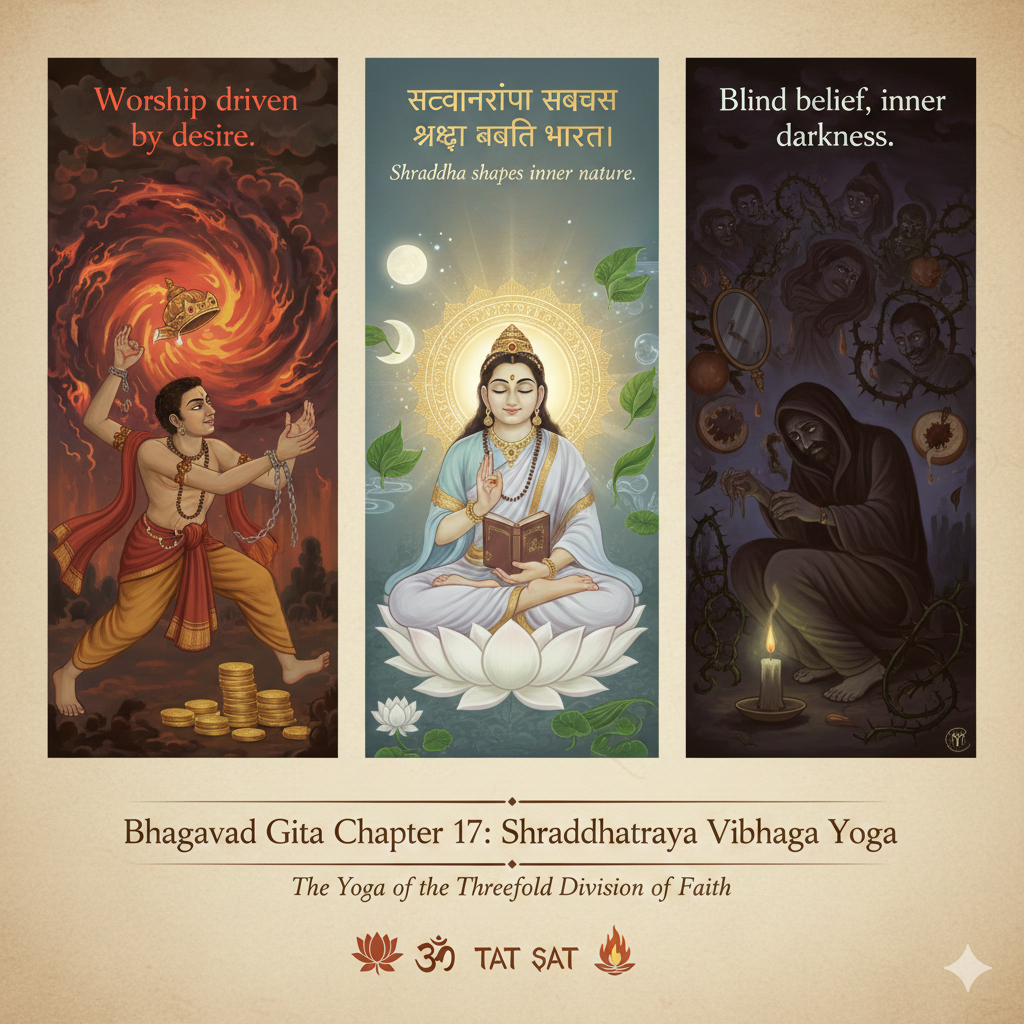
(The Yoga of the Threefold Division of Faith)
Introduction
Chapter 17 of the Bhagavad Gita explores one of the most subtle yet powerful forces in human life — faith (Shraddha). Lord Krishna explains that faith is not random; it is shaped by one’s inner nature and determines thoughts, actions, and destiny.
This chapter helps seekers understand why people worship differently, act differently, and live differently, even when seeking truth.
Central Theme of Chapter 17
Lord Krishna teaches that:
- Faith arises from one’s dominant guna
- Faith shapes lifestyle, worship, and discipline
- Actions without right faith lose spiritual power
- True faith purifies and uplifts the soul
Understanding faith is essential for conscious spiritual growth.
The Three Types of Faith
1. Sattvic Faith
Characteristics:
- Pure intention
- Worship of the Divine with reverence
- Discipline guided by wisdom
- Food, actions, and practices that promote clarity
Effect:
- Leads to peace, balance, and spiritual elevation
2. Rajasic Faith
Characteristics:
- Worship driven by desire and ambition
- Attachment to results
- Ego-centered effort
- Discipline performed for recognition
Effect:
- Leads to restlessness and dissatisfaction
3. Tamasic Faith
Characteristics:
- Blind belief without understanding
- Harmful or misguided practices
- Laziness or superstition
- Neglect of purity and ethics
Effect:
- Leads to confusion and inner darkness
Threefold Discipline (Tapas)
Lord Krishna explains discipline on three levels:
- Body: Cleanliness, humility, non-violence
- Speech: Truthful, gentle, and uplifting words
- Mind: Calmness, self-control, and inner silence
When practiced with faith, discipline purifies consciousness.
Faith in Sacrifice, Charity, and Austerity
True spiritual acts must be:
- Done with sincerity
- Free from ego and expectation
- Performed with devotion
Actions without faith or awareness lose their spiritual essence.
The Meaning of “Om Tat Sat”
Lord Krishna reveals Om Tat Sat as symbols of the Absolute Truth:
- Om – Presence of the Divine
- Tat – Offering without attachment
- Sat – Truth and righteousness
These align actions with higher consciousness.
Practical Relevance in Modern Life
Chapter 17 helps in:
- Understanding belief patterns
- Avoiding blind faith and extremes
- Refining spiritual practices
- Healing confusion and doubt
- Building authentic devotion
This chapter is especially useful for spiritual guidance, faith healing, and conscious living.
Takeaway Shloka (Correct Sanskrit)
Bhagavad Gita 17.3
सत्त्वानुरूपा सर्वस्य श्रद्धा भवति भारत।
श्रद्धामयोऽयं पुरुषो यो यच्छ्रद्धः स एव सः॥
Meaning:
A person’s faith is shaped by their inner nature. Whatever faith one has, that is what one truly becomes.
Key Learnings from Chapter 17
- Faith defines character and destiny
- Purity of intention matters more than ritual
- Awareness refines belief
- True faith leads to liberation
Conclusion
Chapter 17 of the Bhagavad Gita reminds us that faith is the foundation of life itself. When faith becomes conscious, pure, and selfless, every action turns into a spiritual offering.
Right faith leads the soul toward peace, clarity, and freedom.
Leave a Reply