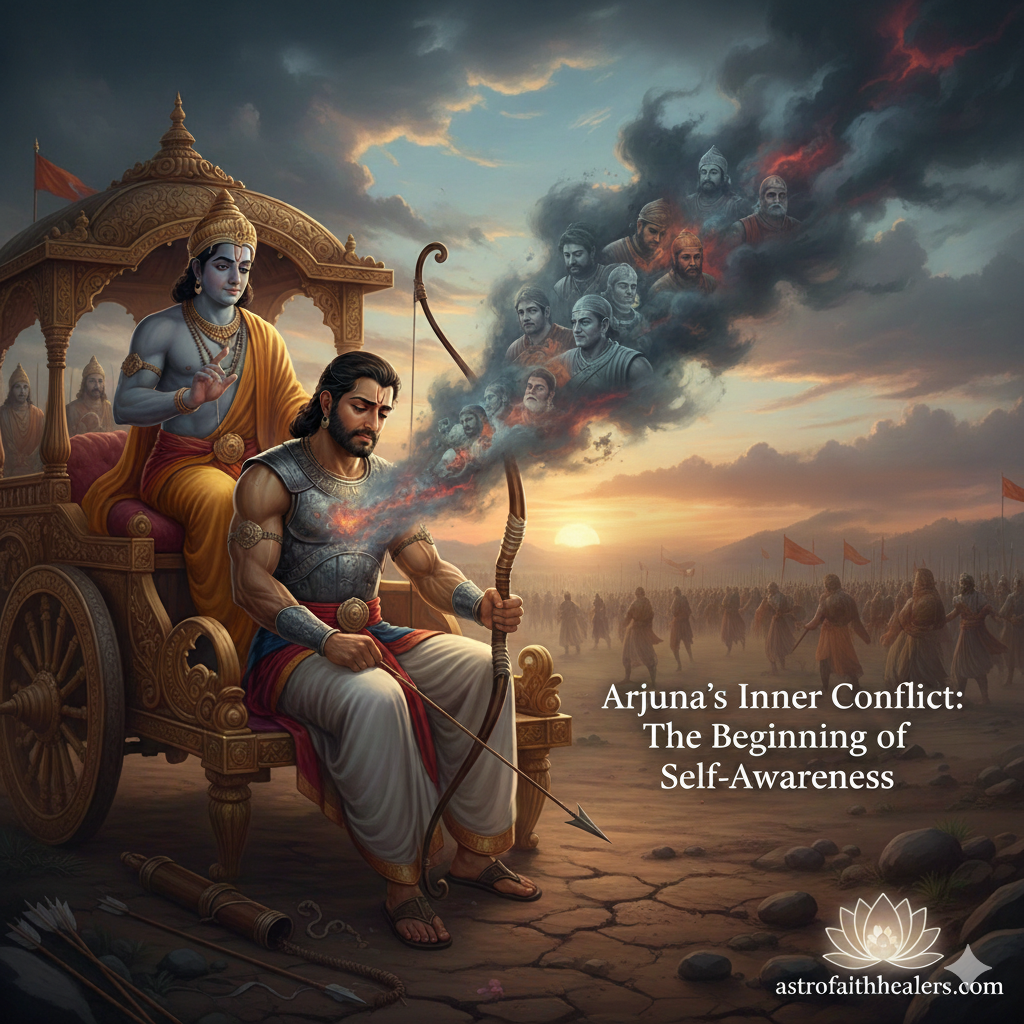
When the Mind Trembles Before Life’s Battles
Have you ever felt frozen when life demanded a difficult decision?
When your heart said one thing, your duty another, and your mind felt heavy with fear, doubt, and emotional pain?
This moment of confusion is not weakness.
It is the beginning of self-awareness.
Bhagavad Geeta Chapter 1, called “Arjuna Vishada Yoga” (The Yoga of Arjuna’s Despair), begins exactly at this sacred human moment — when the mind collapses under emotional pressure and seeks higher wisdom.
This chapter does not preach solutions.
It reveals the problem of the human mind.
What Is Bhagavad Geeta Chapter 1 About?
Chapter 1 sets the foundation of the entire Bhagavad Geeta.
It shows us:
- The conflict between emotion and duty
- The restlessness of the mind
- The fear of loss and attachment
- The moment when ego surrenders and seeks guidance
Before spiritual knowledge begins, confusion must be acknowledged.
Arjuna, a mighty warrior, stands on the battlefield of Kurukshetra.
Yet the real battle is inside his mind.
The Battlefield as a Symbol of Life
Kurukshetra is not just a physical battlefield.
It symbolizes human life.
- Pandavas and Kauravas represent positive and negative tendencies within us
- Friends and relatives represent emotional attachments
- War represents life challenges and moral dilemmas
Every day, we stand on our own Kurukshetra —
choosing between fear and courage, comfort and growth, ego and surrender.
Arjuna’s Emotional Breakdown: A Spiritual Mirror
When Arjuna sees his teachers, elders, friends, and relatives on the battlefield, his confidence collapses.
He experiences:
- Trembling body
- Dry mouth
- Emotional overwhelm
- Loss of motivation
- Inner confusion
This is not cowardice.
This is mental and emotional overload — something many people experience today as stress, anxiety, or fear of difficult decisions.
The Geeta gently reminds us:
Even the strongest can feel lost.
A Shloka That Captures Arjuna’s Inner Storm
At the peak of his emotional collapse, Arjuna expresses his state in a few simple yet powerful words:
दृष्ट्वेमं स्वजनं कृष्ण युयुत्सुं समुपस्थितम्।
सीदन्ति मम गात्राणि मुखं च परिशुष्यति॥
(Bhagavad Geeta 1.28)
In simple terms, Arjuna is saying:
“Seeing my own people ready for battle, my body weakens and my strength leaves me.”
This is not just poetry.
It is the psychology of the human mind.
In one shloka, the Geeta shows how inner conflict first appears in the body — trembling, heaviness, dryness, and loss of clarity.
What Arjuna experiences is the same state many people feel during emotional stress or anxiety today.
The message is gentle and clear:
Your emotions are not your enemy. They are signals asking for awareness and guidance.
Why Arjuna Refuses to Fight
Overwhelmed by emotion, Arjuna begins to question the purpose of the war.
He feels:
- Victory will bring guilt, not joy
- Wealth and power feel meaningless
- Harming loved ones feels unbearable
His thoughts sound noble, but Krishna understands something deeper.
Arjuna is not speaking from wisdom —
he is speaking from attachment and fear.
Spiritual Insight: Attachment Clouds Clarity
Chapter 1 teaches a timeless truth:
When emotions dominate, wisdom becomes silent.
Arjuna’s compassion is real, but it lacks balance.
Attachment binds the mind and weakens decision-making.
From an energy-healing perspective, this reflects a heart full of emotion without grounding — love without clarity leads to suffering.
True compassion arises from inner stability, not emotional collapse.
Mind Training Lesson from Chapter 1
Bhagavad Geeta Chapter 1 is a masterclass in understanding the mind.
It teaches us:
- The mind creates fear by imagining loss
- Emotional attachment drains inner strength
- Avoidance feels safe but leads to stagnation
- Confusion is a sign that guidance is needed
Instead of suppressing confusion, the Geeta invites us to observe it honestly.
The Turning Point: Arjuna’s Surrender
The most powerful moment of Chapter 1 is not despair —
it is surrender.
Arjuna lays down his bow and admits:
“I am confused about my duty. Please guide me.”
This single act changes everything.
Spiritual growth begins not when we have answers,
but when we are humble enough to seek them.
Faith Healing Perspective: When Ego Steps Back
In faith healing, surrender opens the door to inner healing.
- Ego says: “I know what is right”
- Faith says: “Guide me toward what is right”
When control is released, divine wisdom flows naturally.
Surrender is not weakness — it is alignment with higher truth.
Simple Healing Practice Inspired by Chapter 1
Inner Clarity Practice (5 Minutes Daily):
- Sit quietly and close your eyes
- Place one hand on your heart
- Take five slow, deep breaths
- Mentally say:
“I surrender my confusion and open myself to guidance.” - Sit in silence for a moment
This practice gently calms the mind and restores inner balance.
Affirmation from Chapter 1
“It is safe for me to pause, reflect, and seek higher wisdom.”
Repeat this whenever you feel emotionally overwhelmed.
Why Chapter 1 Is Essential for Spiritual Growth
Many readers rush toward Krishna’s teachings, but Chapter 1 prepares the mind to receive them.
This chapter teaches:
- Awareness before action
- Honesty before healing
- Surrender before transformation
Without understanding Arjuna’s confusion, divine wisdom cannot fully enter.
Closing Message: Your Confusion Is Sacred
If you feel uncertain, emotionally tired, or stuck —
you are not failing.
You are standing exactly where Arjuna stood.
This is not the end of your strength.
It is the beginning of your awakening.
In the next chapter, divine wisdom unfolds —
because surrender has already happened.
🌿 Gentle Invitation
If this teaching resonates with you, explore more spiritual guidance, mind-training insights, and healing wisdom on astrofaithhealers.com.
You are always supported on your journey.
Leave a Reply