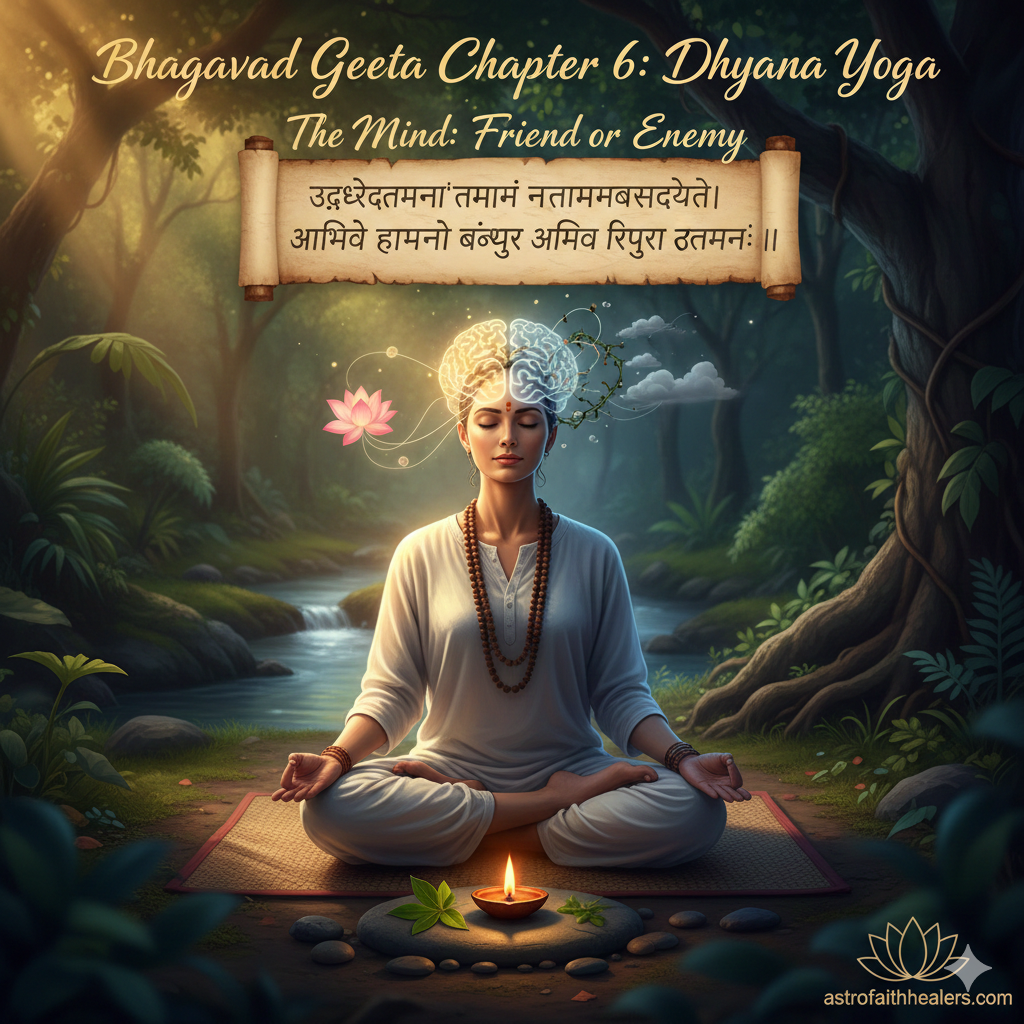
When the Mind Becomes the Biggest Challenge
After learning wisdom, selfless action, and inner renunciation, a sincere seeker faces an honest realization:
I understand the teachings… but my mind does not stay still.
Thoughts wander.
Emotions fluctuate.
Focus breaks again and again.
Bhagavad Geeta Chapter 6 acknowledges this reality with compassion.
It introduces Dhyana Yoga — the path of meditation and self-discipline — to help the seeker master the restless mind.
What Is Bhagavad Geeta Chapter 6 About?
Chapter 6 focuses on:
- The nature of the restless mind
- The practice of meditation
- Self-discipline and balance
- Inner friendship vs self-conflict
- How peace is cultivated gradually
This chapter teaches that inner mastery is possible, but it requires patience, consistency, and compassion toward oneself.
The Mind: Friend or Enemy
Krishna gives one of the most practical teachings of the Geeta:
The mind can be:
- Your greatest friend when disciplined
- Your biggest obstacle when uncontrolled
When the mind is guided by awareness, it supports growth.
When driven by impulses, it creates suffering.
The goal of Dhyana Yoga is not to fight the mind, but to train it gently.
A Shloka That Defines Inner Mastery
Krishna expresses this truth clearly:
उद्धरेदात्मनाऽत्मानं नात्मानमवसादयेत्।
आत्मैव ह्यात्मनो बन्धुरात्मैव रिपुरात्मनः॥
(Bhagavad Geeta 6.5)
In simple words:
“Elevate yourself through your own mind. The mind can be your friend or your enemy.”
This shloka reminds us that healing and growth begin within.
Spiritual Insight: You Are Responsible for Your Inner State
External situations influence us, but they do not control us.
Our inner state depends on:
- How we respond
- How we train the mind
- How gently we return to awareness
This realization restores inner power without pressure.
Self-responsibility is not self-blame —
it is self-empowerment.
The Practice of Meditation (Dhyana)
Krishna gives simple, practical guidance for meditation:
- Sit in a clean, quiet place
- Keep the spine steady
- Focus the mind gently
- Avoid extremes of indulgence or suppression
Meditation is not escape.
It is returning to the center again and again.
Arjuna’s Honest Doubt About the Mind
Arjuna openly admits:
“The mind is restless, turbulent, strong, and difficult to control.”
Krishna does not dismiss this concern.
Instead, he reassures:
- The mind can be trained
- Through practice (abhyasa)
- And detachment (vairagya)
This makes the teaching deeply human and realistic.
Mind Training Lesson from Chapter 6
Chapter 6 teaches:
- Consistency is more important than perfection
- Even small daily practice matters
- Failure is part of training
- Returning gently is success
A calm mind is not created overnight.
It is cultivated slowly, like healing.
Faith Healing Perspective: Balance Is the Key
Krishna emphasizes moderation:
- Balanced eating
- Balanced sleep
- Balanced work
- Balanced rest
Extreme lifestyles disturb energy and mind.
From a healing perspective, balance restores:
- Nervous system stability
- Emotional harmony
- Mental clarity
Spiritual growth flourishes in balance, not force.
Simple Healing Practice Inspired by Chapter 6
Gentle Meditation Practice (5–7 Minutes):
- Sit comfortably with a straight spine
- Close your eyes and observe your breath
- When the mind wanders, gently bring it back
- Do not judge or force
- End with gratitude
This practice builds inner steadiness over time.
Affirmation from Chapter 6
“I gently train my mind and return to inner peace.”
Repeat this whenever the mind feels restless.
Why Chapter 6 Is Deeply Compassionate
This chapter reassures seekers who struggle.
It teaches:
- You are not failing if your mind wanders
- Restlessness is part of the journey
- Progress comes through patience
- Inner peace is achievable
The Geeta does not demand perfection —
it encourages persistent gentleness.
Closing Message: Become a Friend to Your Mind
Your mind does not need punishment.
It needs understanding, training, and kindness.
When the mind becomes your friend,
peace stops being temporary and becomes natural.
Bhagavad Geeta Chapter 6 reminds us:
Inner mastery is the foundation of lasting peace.
🌿 Gentle Invitation
Continue your journey through the Bhagavad Geeta and explore meditation, mind-training, and healing wisdom on astrofaithhealers.com.
Each calm breath is a step closer to yourself.
Leave a Reply