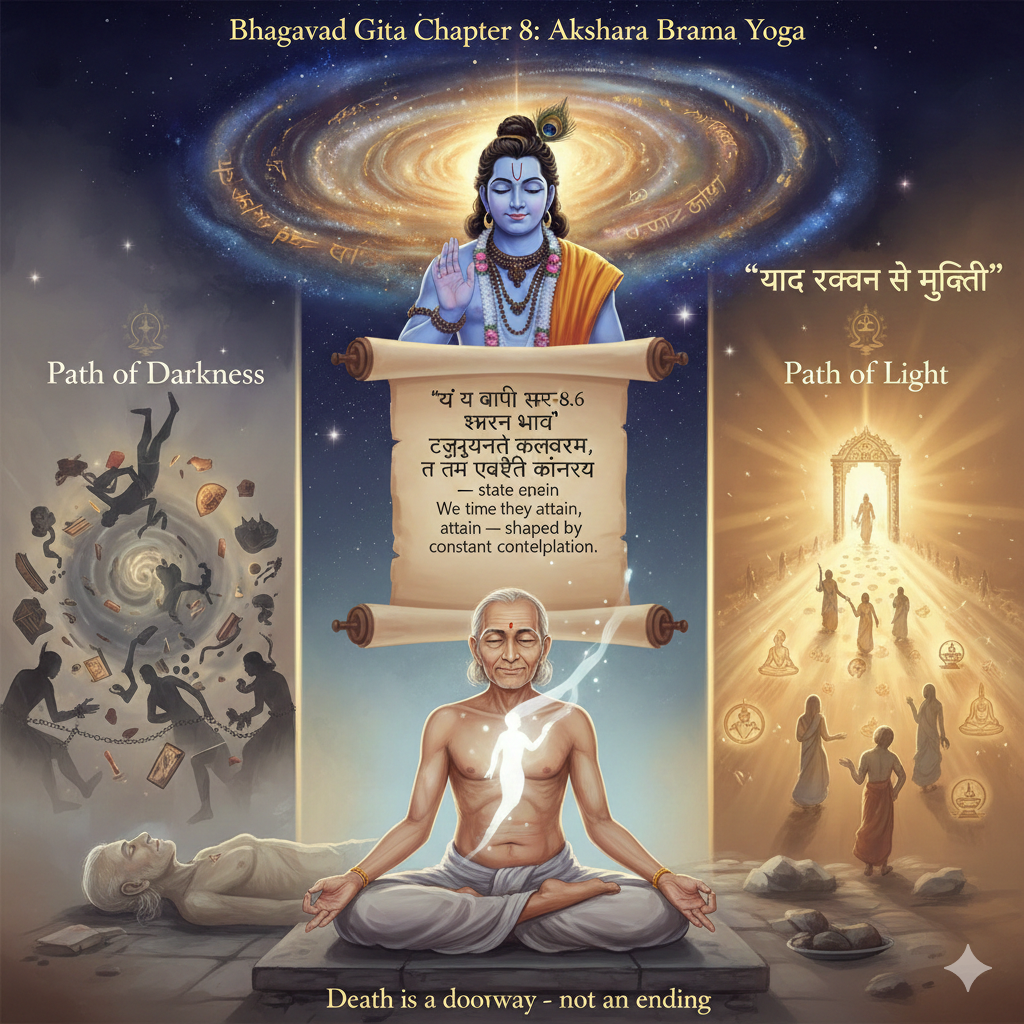
The Yoga of the Imperishable Absolute
Spiritual Opening: What Happens After Death?
At some point in life, a silent question arises in every heart:
“What happens after death?”
“Does anything remain when the body ends?”
In Chapter 8 of the Bhagavad Gita, Arjuna asks these very questions.
Lord Krishna responds with deep compassion, explaining the eternal truth of the soul, the power of remembrance, and how consciousness at the final moment shapes our future journey.
This chapter gently removes fear of death and replaces it with clarity, awareness, and faith.
Essence of Chapter 8
In this chapter, Lord Krishna explains:
- The meaning of Brahman, soul, karma, and devotion
- What decides one’s state after death
- Why the last thought is extremely powerful
- How regular spiritual practice prepares us for liberation
Krishna teaches that death is not an end — it is a transition guided by awareness.
Core Teachings of Chapter 8
1. The Imperishable Reality (Akshara Brahma)
Krishna explains that:
- Brahman is eternal, unchanging consciousness
- The soul is also imperishable
- The body is temporary, but awareness continues
Understanding this truth removes fear and attachment to physical identity.
2. Karma Shapes the Journey of the Soul
Every action leaves an impression.
Krishna explains:
- Karma influences future experiences
- Unresolved desires pull the soul toward rebirth
- Awareness helps release karmic bondage
Conscious living today creates peaceful transitions tomorrow.
3. Power of the Final Thought
One of the most important teachings of this chapter:
Whatever a person remembers at the time of death,
they attain that state.
This is why Krishna emphasizes daily remembrance, not last-minute effort.
4. Devotion as Constant Awareness
True devotion is not ritual alone.
Krishna teaches:
- Remember the Divine while working
- Offer actions with sincerity
- Live with inner connection
When remembrance becomes natural, liberation becomes effortless.
5. Two Paths After Death
Krishna explains two symbolic paths:
- Path of Light → leads to liberation
- Path of Darkness → leads to rebirth
These paths represent levels of consciousness, not punishment or reward.
Healing Insight: Reiki & Energy Perspective
From an energy-healing view, Chapter 8 teaches:
- Consciousness is energy
- Final thoughts reflect dominant vibration
- Daily awareness purifies subtle energy channels
Practices like meditation, Reiki, and mindful living help the soul remain light, calm, and centered, even during life’s transitions.
Takeaway Shloka from Chapter 8
Bhagavad Gita 8.6
“Yaṁ yaṁ vāpi smaran bhāvaṁ
Tyajaty ante kalevaram
Taṁ tam evaiti kaunteya
Sadā tad-bhāva-bhāvitaḥ”
Meaning:
“Whatever state of being one remembers at the time of death,
that state they attain — shaped by constant contemplation.”
Practical Life Lesson
Do not wait for the last moment to become spiritual.
Instead:
- Train the mind daily
- Practice gratitude and remembrance
- Reduce fear and attachment
- Live consciously, not mechanically
A peaceful life creates a peaceful transition.
Closing Message: Death Is Not the End
Chapter 8 gently reassures us:
You are not the body.
You are not the fear.
You are eternal awareness.
When life is lived with remembrance,
death becomes a doorway — not an ending.
Leave a Reply